



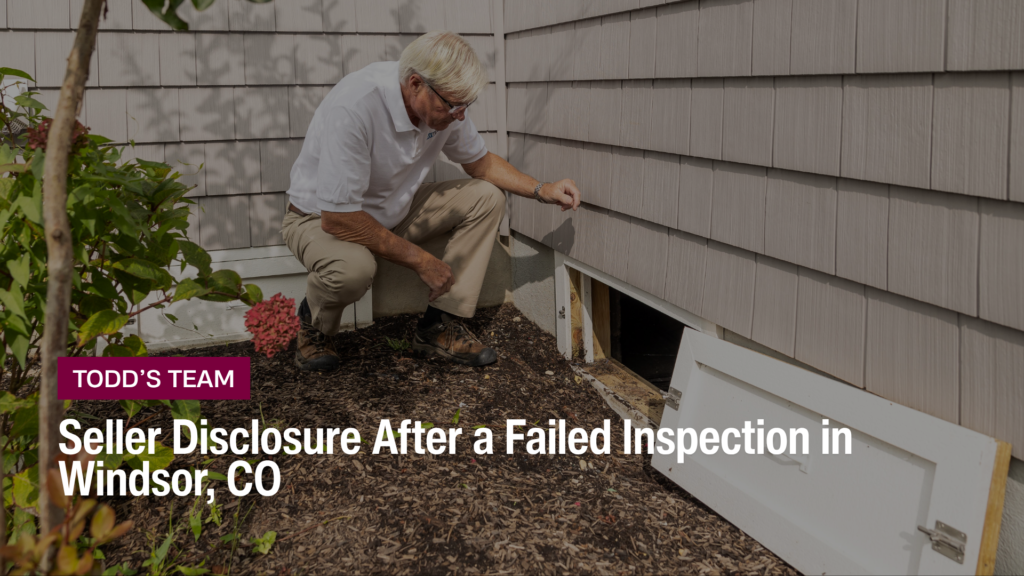
Seller disclosure after a failed inspection in Windsor, CO sellers face splits into two questions. You do have to disclose conditions you now actually know about, because Colorado’s disclosure form is built on your current actual knowledge. You do not have to hand the next buyer the previous buyer’s inspection report, a private document that buyer paid for.
What Changes the Moment You Read That Report
The report flagged a subpanel, grading against the foundation, and an aging water heater. The buyer terminated. A new buyer is coming.
Before the inspection you may not have known about the subpanel. Now you do. Colorado’s Seller’s Property Disclosure asks you to answer to your current actual knowledge as of the date you sign, so an April form can be stale by September. Your listing broker carries a parallel obligation to disclose known adverse material facts.
Not every line reaches that level. Inspectors note everything, including normal wear. What usually belongs on an updated disclosure:
- A defect you did not previously know about
- Anything you repaired, tried to repair, or got a bid on
- The issue that caused the buyer to walk
- Structural, roof, sewer, water, or electrical items
The Report Belongs to the Buyer Who Paid for It
Inspectors work under contract with their client, and that client was the buyer. The InterNACHI Code of Ethics bars members from releasing information about the inspection or the client to a third party without explicit prior written consent. The report is not yours to redistribute.
Keeping it out of circulation also protects you. A new buyer may rely on a document you cannot explain, and a second inspector may disagree. You own the gap.
Seller Disclosure After a Failed Inspection Windsor CO: What Goes on the Form
Describe the condition in your own words and what you did about it. If you repaired it, say what was done and who did it. If not, say that too. Invoices and permits do more for you than a forwarded PDF, especially with unpermitted work or radon mitigation.
| Approach | What It Does for You | What to Watch |
|---|---|---|
| Disclose the condition | Meets the obligation | Must be accurate |
| Forward the prior report | Looks transparent | Buyer relies on something you cannot verify |
| Provide invoices and permits | Shows the issue was handled | Only helps if done properly |
| Stay quiet about a known defect | Nothing | Real liability if it resurfaces |
How the Next Buyer Reacts
Buyers notice almost everything, care about less, pay for less still, and use the rest as leverage.
| What the Buyer Sees | Typical Reaction | What Todd Would Evaluate |
|---|---|---|
| Disclosed, repaired, invoice attached | Usually a non-event | Whether the work was permitted |
| Disclosed, unrepaired, price reflects it | Negotiation, not termination | Whether comparables support the price |
| Undisclosed, found by their inspector | Leverage, often distrust | Whether the second finding reads worse |
What Todd Reviews Before Recommending an Approach
- The objection notice, and whether it named a reason
- Which findings a licensed trade verified versus only flagged
- How the prior inspection objection and resolution deadlines played out
- Whether the earnest money question is still unresolved
- Whether a sewer scope before relisting is worth it
Frequently Asked Questions
Do I have to tell the next buyer why my last deal fell through?
You have to disclose the conditions you learned about. You are not required to narrate the transaction, and terminations often come down to financing or cold feet, not the house.
Days on market and a back on market date are public, though, and buyers ask. A short factual answer with documentation behind it beats a vague one.
What if I think the inspector was wrong?
Disagreeing does not erase that it was raised. Have the right licensed trade evaluate it and put the finding in writing.
If the electrician says the subpanel is compliant, you have an answer ready before the next inspector raises it.
If I fix the problem, do I still have to disclose it?
Usually yes, and the form asks about past repairs directly. The disclosure is not the liability. The concealment is.
A repaired, documented item rarely costs you at the table. The same item found again by a second inspector costs twice, in the repair and in the buyer’s confidence.
Can my agent just give the report to the next buyer’s agent?
That is the buyer’s document, and passing it along without consent is the part sellers underestimate. Your broker’s duty runs to disclosing known adverse material facts, not to distributing someone else’s work.
Put the condition on the disclosure and offer your own documentation.
Should I get my own inspection before relisting?
It depends on how many findings there were and how confident you are in the ones that matter. A pre-listing inspection buys time to price, repair, or explain on your schedule.
The tradeoff is that whatever it finds becomes knowledge you then disclose. With one issue already identified, a targeted specialist evaluation is often the better spend.
What Seller Disclosure After a Failed Inspection in Windsor CO Comes Down To
The instinct to hand over the old report comes from a good place. But it answers a question nobody asked while leaving the real obligation, your own updated disclosure, untouched. Transparency about the document is not the same as accuracy on the form, and sellers who get that backward can end up worse off than quieter ones.
Todd can help you sort which findings changed what you know, how to word them, what documentation strengthens each, and how the next buyer will read the file. Where a finding raises legal or title questions beyond a broker’s scope, he can flag what belongs with an attorney.
He can also show what similar Windsor homes with disclosed, repaired issues sold for. Sometimes the answer is to repair. Sometimes it is to disclose, price around it, and leave it alone. Todd can review what seller disclosure after a failed inspection in Windsor, CO requires in your situation. Call or text 970-286-5390.