

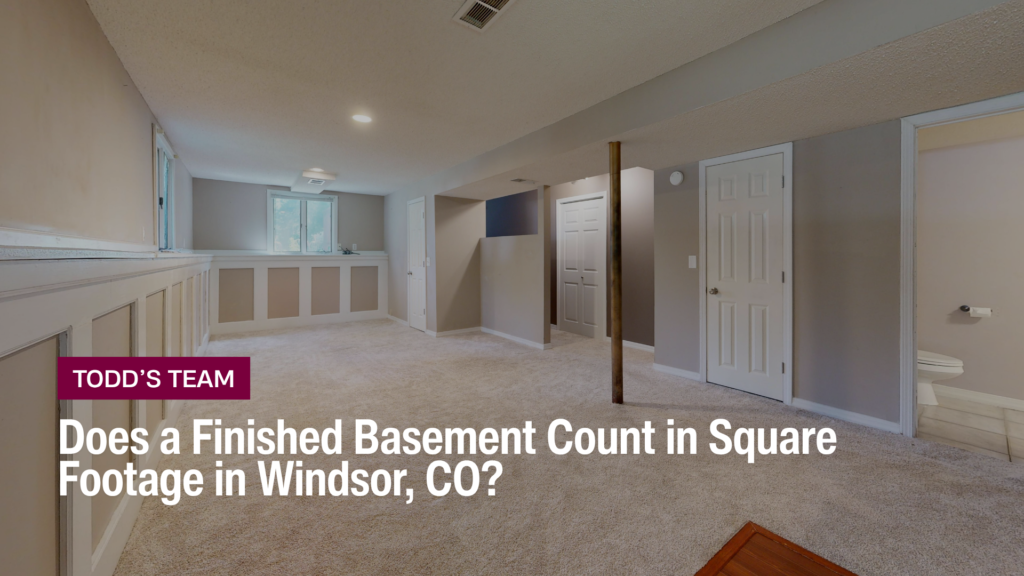
Does a finished basement count in square footage in Windsor, CO? It counts, but not as one blended number. Above-grade and below-grade finished space are measured and reported separately, so 1,800 above-grade feet plus a 600-foot finished basement is marketed as both figures, not a single 2,400.
A county record of 1,800 against your measurement of 2,400 is not proof anyone erred. The numbers were built for different jobs, and only one describes what buyers shop for.
Why the County Number and Your Number Disagree
The Weld County Assessor has a constitutional duty to discover, list, classify, and value all property in the county for tax purposes. Characteristics on file come from builder plans, permit records, and periodic review, not a fresh measurement before a sale.
A basement finished without a permit may never have reached the file. Just as often, the county has that area on a separate basement line that never rolls into the headline number.
Does Finished Basement Count in Square Footage Windsor CO Appraisers Report?
It counts, on its own line. Appraisers measure under the ANSI Z765-2021 standard, and Fannie Mae’s appraisal requirements state that a walk-out below-grade area with finished rooms is not included in above-grade square footage, and that appraisers report below-grade area separately.
| Source | What It Captures | What It Drives |
|---|---|---|
| Weld County record | Characteristics on file | Property tax valuation |
| MLS above-grade field | Finished area at or above grade | Search filters, price per foot |
| MLS basement field | Finished area below grade | A separate value adjustment |
| Appraisal report | Measured area, split by grade | The lender’s decision |
Which Number Goes on the Listing
Both, in their own fields. Publishing 2,400 as a single living-area figure causes the trouble: the appraiser splits it back apart and the buyer feels it walking through.
| How You Report It | What Buyers Conclude | What Happens Later |
|---|---|---|
| 1,800 above grade plus 600 finished | Accurate expectation up front | Appraisal matches the listing |
| 2,400 as total living area | Home feels smaller than advertised | Mismatch and lost credibility |
| 1,800 only, basement left out | Reads as a bonus, not value | Value left on the table |
Finished basement space rarely carries main-level per-foot value, and the gap is not a fixed discount. Walk-out and garden-level rooms with full windows narrow it. Low, dark rooms widen it. Paired sales settle it, which is part of why agents give different list prices.
Before deciding how to report it, Todd looks at:
- Whether the finish was permitted and inspected
- Ceiling height, window size, and egress below grade
- Whether the level is walk-out, garden, or fully below grade
- How competing listings report their basements
- Which recent sales show a real adjustment for finished space
Correcting a County Record That Is Genuinely Wrong
- Pull the full property card and confirm what the county has.
- Check Town of Windsor building permit history for the finish and inspection.
- Have the home measured to standard if the gap is above grade.
- Contact the assessor with documentation if it is incorrect.
- Keep a one-page summary, which beats a folder of home improvement receipts.
Worth saying plainly: adding finished area to the county record can raise your assessed value and tax bill. Correct a wrong record anyway. If you misread it, leave it alone.
Frequently Asked Questions
Should we correct the county record before we list, or after?
Before listing only if the above-grade number is wrong, since that figure drives search filters and price per foot. A basement discrepancy matters less, since the MLS carries it separately.
Todd would rather list on accurate MLS data than wait on a tax record buyers never see.
Is finished basement space really worth less per square foot?
It depends on the space. Buyers pay close to main-level value for a walk-out with full windows and nine-foot ceilings, and far less for a low, dark bonus room.
Paired sales in your subdivision answer it better than a percentage rule, and that number has to survive pricing your Windsor home.
Can we just measure the house ourselves?
You can, but a seller’s tape measure is not what goes in the MLS. Exterior measurement, sloped-ceiling rules, and stairwell treatment change the result.
If the gap is meaningful, a measurement from a licensed appraiser or floor-plan service is cheap insurance.
What if the basement was finished without a permit?
It can still be reported as finished space, but the disclosure obligation stays and buyers will ask. Egress windows and ceiling height are what turn a permit question into a financing one.
The right move depends on the buyer pool and the work quality. Todd covers those tradeoffs under selling a home with unpermitted work.
Will the appraiser use our number or the county’s?
Neither. The appraiser measures the house and reports each area separately, which is why one blended figure creates a gap.
That gap is workable when the pricing underneath is sound, a thread in what happens if the appraisal comes in low.
Deciding Whether a Finished Basement Counts in Square Footage on Your Windsor, CO Listing
The tension is real. Reporting 2,400 wins searches and looks larger on paper. Reporting 1,800 plus 600 feels like giving something away, and the bigger number loses it back at the showing.
Todd can help you sort out what your county record says, whether the gap sits above or below grade, and what to have ready before the buyer’s appraiser arrives. Where it crosses into permits, disclosure, or tax assessment, he can point you to the right person at the town, the assessor, or an attorney.
In practice that means pulling the property card, comparing how nearby sales with finished lower levels were reported and what they closed for, and showing whether the extra 600 feet is worth a correction or just good marketing.
If you’re still asking does a finished basement count in square footage in Windsor, CO? Todd can show you the numbers. Call or text 970-286-5390.